
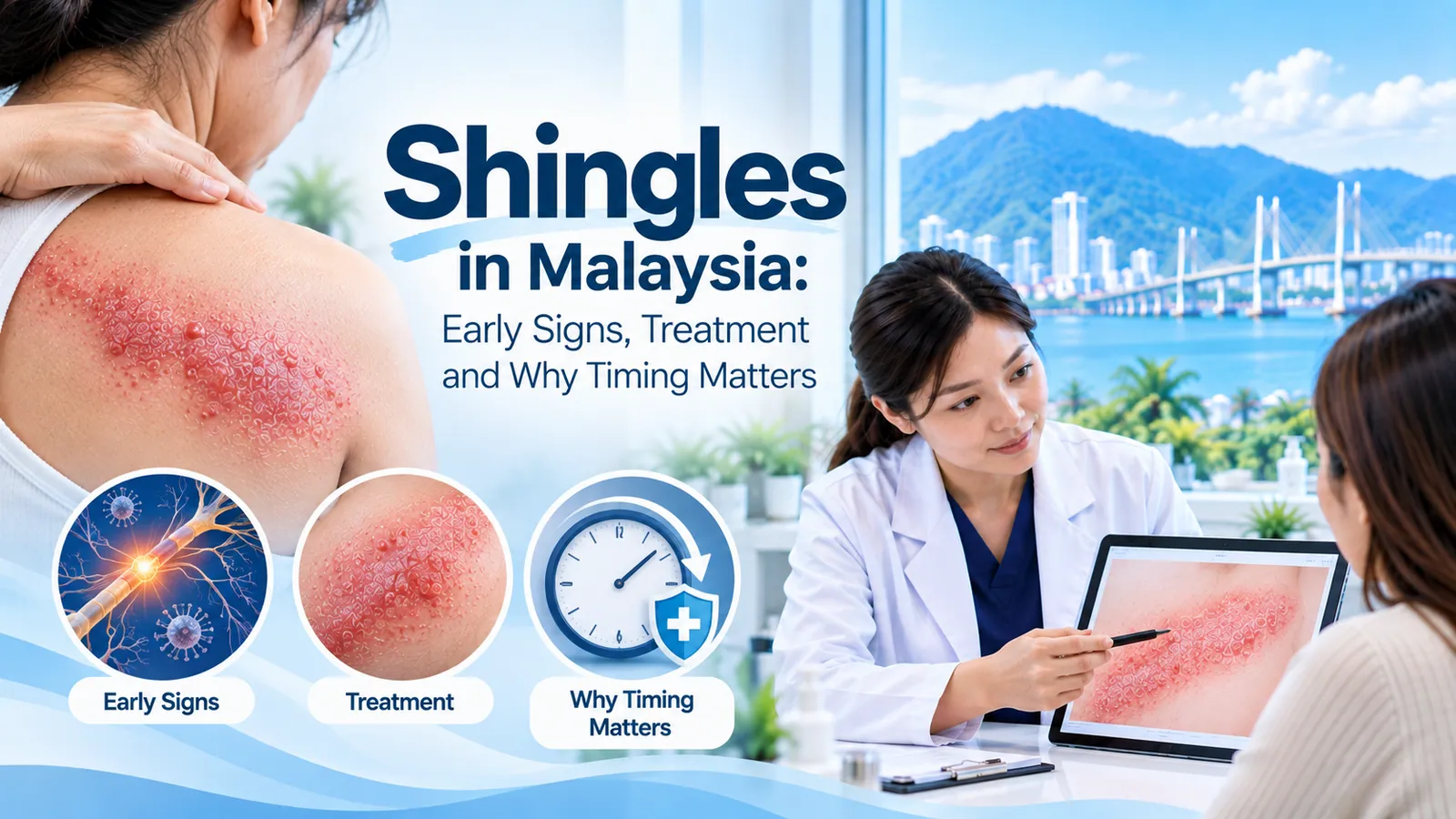
Shingles is the chickenpox virus reactivating. It never leaves the body after childhood infection — it lies dormant in the nerve roots, and when it wakes it travels down one nerve to produce burning pain and blisters in a single band on one side of the body. Antiviral treatment works best within 72 hours of that rash appearing.
The short answer
Shingles (herpes zoster, locally kayap) is the varicella-zoster virus — the same virus that caused your chickenpox — reactivating from nerve roots where it has lain dormant for years.
The giveaway is pain, burning or tingling in a band on one side of the body, often one to five days before any rash, then clustered blisters in that same band that do not cross the midline.
Antiviral treatment is most effective within 72 hours of the rash appearing. Starting in that window shortens the attack and lowers the risk of nerve pain lasting months. If you suspect shingles, get assessed the same day.
What shingles is — and why it comes back
Shingles is not a new infection; it is an old one restarting. When you had chickenpox your immune system cleared the illness but not the virus. Varicella-zoster retreated into clusters of nerve cells beside the spinal cord and at the base of the skull, and stayed there, silent, for decades.
Your immune system keeps it suppressed. When that suppression weakens the virus replicates again, travels along the nerve it has been hiding in, and reaches the strip of skin that nerve supplies. That strip is a dermatome, and it explains everything odd about shingles: why the rash is a band, why it is one-sided, and why pain usually comes first — the nerve is inflamed before the skin is. Control commonly weakens with age (risk climbs after 50), serious illness, cancer treatment, medicines that suppress immunity including long steroid courses, and major stress. Often there is no identifiable reason.
Key points
- You can only get shingles if you have had chickenpox at some point.
- The virus lives in nerve roots, not skin — the rash is the end of the journey.
- One side, one band, not crossing the midline. That pattern is the diagnosis.
- Pain can precede the rash by one to five days — the window most people miss.
- Antivirals work best within 72 hours of the rash appearing.
The early signs, before any rash appears
Shingles usually announces itself through sensation, not appearance. For one to five days before the rash, a band of skin feels wrong: burning, tingling, crawling, itching, numbness, or deep aching or stabbing pain. The skin can become so sensitive that clothing brushing it hurts. Many people also feel unwell — headache, mild fever, fatigue.
Because nothing is visible yet, this phase gets mistaken for a muscle strain around the chest, a kidney problem in the flank, or toothache and sinus on the face. The clue that separates it is the pattern: the discomfort sits in a strip on one side and stops at the midline. If that is what you feel, note the date — when a rash appears in that same strip, the 72-hour clock starts and you already know what you are looking at.
What the shingles rash looks like
The rash starts as red or pink patches in the painful band, usually one to five days after the first symptoms. Small fluid-filled blisters then appear in tight clusters, often described as a strip of dewdrops. New blisters keep forming for roughly three to five days, then cloud, dry and crust over.
Common sites are one side of the ribs or back, the abdomen or flank, one side of the face or forehead, the neck, or one limb. The defining feature is that it respects the midline: a band of blisters on the left ribs stopping cleanly at the breastbone is shingles, not an allergy, not a fungal rash, not heat rash. A widespread rash on both sides is a different situation and needs urgent assessment.
Why timing matters: the 72-hour window
Antiviral medicine for shingles works best when started within 72 hours of the rash appearing. Antivirals do not kill the virus or clear it from the nerve roots — nothing does. They block its ability to copy itself, which is only useful while active replication is still happening: the first few days. Once replication is over and the nerve damage is done, the medicine has far less to act on.
Treatment inside that window is associated with faster healing, less severe pain during the attack, and a lower chance of pain persisting afterwards. Later treatment is not useless — it may still be given if new blisters are appearing, if the face or eye is involved, if symptoms are severe, or if immunity is weakened — but the benefit is smaller. This is why self-treating first is costly: a few days of trying creams from a pharmacy shelf is usually the whole window, spent.
Shingles day by day
| Stage | What happens |
|---|---|
| Days −5 to −1 | Burning, tingling or deep pain in a band on one side. No rash. Possible headache or mild fever. The phase most people misread. |
| Day 0 to 1 | Red or pink patches appear in the painful band. The 72-hour clock starts here. |
| Days 1 to 5 | Clustered blisters develop and new ones keep forming. Pain usually at its worst. Infectious to anyone who has never had chickenpox. |
| Days 5 to 10 | Blisters cloud, dry and crust over. Once fully crusted, the rash is no longer infectious. |
| Weeks 2 to 4 | Crusts separate and skin heals. Discolouration or scarring can remain, more so if blisters were scratched or infected. |
| Beyond 4 weeks | Most people are back to normal. In some, nerve pain continues in the same band after the skin has healed. |
When shingles is urgent — and when it isn’t
Every suspected case deserves prompt assessment because of the 72-hour window, but some presentations need same-day care.
| Get seen the same day | Usually not an emergency |
|---|---|
| Rash on the forehead, around or near the eye, or on the tip of the nose — sight may be at risk | A band of blisters on the trunk or a limb, pain manageable, no eye, ear or facial involvement |
| Rash on or around the ear, or facial weakness, hearing change, ringing or dizziness | Mild itch or tenderness as the crusts heal |
| Rash spreading widely, or appearing on both sides | Patchy discolouration of healed skin afterwards |
| Significantly weakened immunity — cancer treatment, transplant medicines, long-term steroids | Mild tiredness in the week or two after |
| Severe or uncontrolled pain, high fever, confusion or a stiff neck | Questions about scarring once everything has healed |
| Blisters increasingly red, swollen, hot or oozing pus — possible bacterial infection | Crusts shedding at around two weeks |
Shingles involving the eye, and shingles involving the ear and facial nerve, are where delay carries most risk. If the rash is anywhere on the forehead or around the eye, treat it as same-day and present directly rather than waiting for an appointment.
Postherpetic neuralgia: pain that outlasts the rash
Postherpetic neuralgia is nerve pain continuing in the affected band after the rash has healed. The virus damages the nerve itself, and a damaged nerve can keep sending pain signals long after the skin looks normal. It typically feels like burning, shooting or electric pain in that strip, often with extreme sensitivity to light touch, and can last weeks to months.
Risk rises substantially with age, and is higher when the initial pain was severe, the rash extensive, or treatment delayed. Early antiviral treatment reduces the risk of developing it. Where it does develop it is treated in its own right, with medicines that act on nerve pain rather than ordinary painkillers. Pain persisting after the rash has healed is a reason to go back to a doctor, not to wait it out.
Is shingles contagious?
You cannot catch shingles from someone who has it. Shingles only arises from a virus already dormant in your own nerves. But the fluid inside the blisters contains live varicella-zoster virus, so someone who has never had chickenpox and never been vaccinated against it can catch chickenpox from close contact with it — and could, years later, develop shingles from that. The rash is infectious from when blisters appear until every one has crusted, typically seven to ten days. During that time:
- Keep the rash covered with a loose, non-stick dressing or clothing.
- Wash your hands after touching the area or changing a dressing.
- Do not share towels, bedding or clothing that touches the rash.
- Avoid close contact with newborns, pregnant women who have not had chickenpox, and anyone whose immunity is weakened.
- Avoid swimming and contact sports until the blisters have crusted.
The Malaysian factor: humidity and the pharmacy shelf
First, the climate. Constant heat and humidity keep broken, blistered skin damp, and damp broken skin is an easy target for bacteria. Secondary bacterial infection on top of a shingles rash is more likely here than in a temperate climate, and it is what turns a self-limiting rash into something that scars. Keeping the area clean, cool and genuinely dry is a large part of practical management here: loose cotton over the band, cool water rather than hot showers, patting dry rather than rubbing, and a fan or air conditioning while blisters are active.
Second, the habit of self-treating first. A painful, blistering rash looks to most people like a fungal infection or a bad allergy, so the first stop is a pharmacy for an antifungal or steroid cream. Neither does anything to a virus. By the time the cream has clearly failed, three to five days have gone, and with them the window in which antivirals work best.
While you have shingles: do and don’t
Do
- Get assessed as soon as the rash appears
- Note the date the rash started and tell the doctor
- Keep the area clean, cool and dry
- Cover the rash with a loose, non-stick dressing
- Finish the full course of any medicine as prescribed
- Go back if pain persists after the skin heals
Don’t
- Wait to see whether it settles on its own
- Burst, pick or scratch the blisters
- Apply antifungal or over-the-counter steroid cream hoping it fits
- Put powders, oils or traditional pastes on open blisters
- Visit a newborn, or someone pregnant who has not had chickenpox
- Assume a rash near the eye can wait
What does not help
- Antifungal creams. Shingles is viral; antifungals have no effect, and reaching for one is the commonest reason the 72-hour window is lost.
- Steroid creams on their own. They may dull inflammation while doing nothing to the virus, and can mask the picture when you are finally seen.
- “Letting it dry out”. The rash crusts over eventually regardless; waiting just means the attack runs untreated, with a higher risk of lasting nerve pain.
- Traditional remedies on open blisters. Pastes, oils and powders do not reach the virus and raise the risk of bacterial infection in our humidity.
- Painkillers or supplements as the whole plan. They may help comfort, but do nothing about the virus or the nerve damage driving the pain.
Can shingles be prevented?
There is no way to remove the dormant virus, so prevention is about keeping it suppressed and about vaccination. A shingles vaccine exists and is used to reduce the risk of shingles and of nerve pain afterwards, mainly in older adults and some people with weakened immunity. Whether it is suitable for you, and how to obtain it, is a conversation for a doctor who can review your age, history and medication. Beyond that: keep conditions such as diabetes well controlled, and take persistent unexplained one-sided pain seriously. Having had shingles once does not guarantee it will not return, though repeat episodes are much less common.
Getting a painful one-sided rash assessed
Shingles is diagnosed clinically — from the history and from looking at the rash and where it sits. That is why an in-person assessment matters: a photograph cannot convey where a band stops, how the pain behaves, or whether something else is also going on. No referral is needed in Malaysia. DSH provides doctor-led, non-laser, non-aesthetic medical skin treatment across Penang, Kedah and Perak, and DSH doctors are fully registered medical practitioners, well trained in evidence-based skin healthcare.

Klinik DSH
50 Jalan Masjid Negeri, Georgetown, Penang
014-306 0376
Klinik Bersatu Sungai Nibong
The Sun, 1-1-2, Tingkat Bukit Kecil 3, Bayan Lepas, Penang
010-398 9984Locations are listed on our Penang, Sungai Petani pages. If the rash turns out to be something else — eczema or a fungal infection, for instance — it is managed in the same visit.
Frequently asked questions
What are the early signs of shingles?
Before any rash appears, most people feel burning, tingling, itching or deep pain in a band on one side of the body, usually for one to five days, sometimes with headache or mild fever. The rash then follows in that same band: red patches that develop clustered blisters.
Why does shingles treatment need to start within 72 hours?
Antiviral medicine stops the varicella-zoster virus multiplying, so it works best while the virus is still replicating, within about 72 hours of the rash appearing. Starting in that window shortens the attack, reduces pain and lowers the risk of long-lasting nerve pain. Later treatment may still be given, but the benefit is smaller.
Is shingles contagious?
You cannot catch shingles from another person. But the fluid in the blisters contains live virus, so someone who has never had chickenpox or the chickenpox vaccine can catch chickenpox from close contact with it. Keep the rash covered until every blister has crusted, and avoid newborns, pregnant women who have not had chickenpox, and anyone with weakened immunity.
Why does shingles appear years after chickenpox?
After chickenpox the virus is never fully cleared. It lies dormant in nerve roots beside the spinal cord, held in check by the immune system. When that control weakens, with age, illness, certain medicines or significant stress, it reactivates, travels along one nerve and causes pain and blisters in the strip of skin that nerve supplies.
When is shingles an emergency?
Seek same-day care if the rash is on the forehead, around or near the eye, or on the tip of the nose, because sight may be at risk. Also get seen urgently with facial weakness, ear pain, hearing change or dizziness, with a rash spreading beyond one band, with severe uncontrolled pain, or if your immune system is significantly weakened.
How long does shingles last?
The rash blisters over the first three to five days, crusts by about seven to ten days, and heals over two to four weeks. In some people, particularly older adults, nerve pain continues for months after the skin has healed, which is called postherpetic neuralgia.
What does not help shingles?
Antifungal creams, steroid creams on their own, and traditional pastes applied onto open blisters do not treat the virus and delay the treatment that does. Letting the rash dry out by itself wastes the 72-hour window, and scratching blisters raises the risk of bacterial infection and scarring in Malaysian humidity.
A painful rash on one side? Have it looked at early.
Doctor-led, non-laser, non-aesthetic medical skin care across Penang, Kedah and Perak. No referral needed — and with shingles, timing changes the outcome.
Find your nearest clinicContact us