
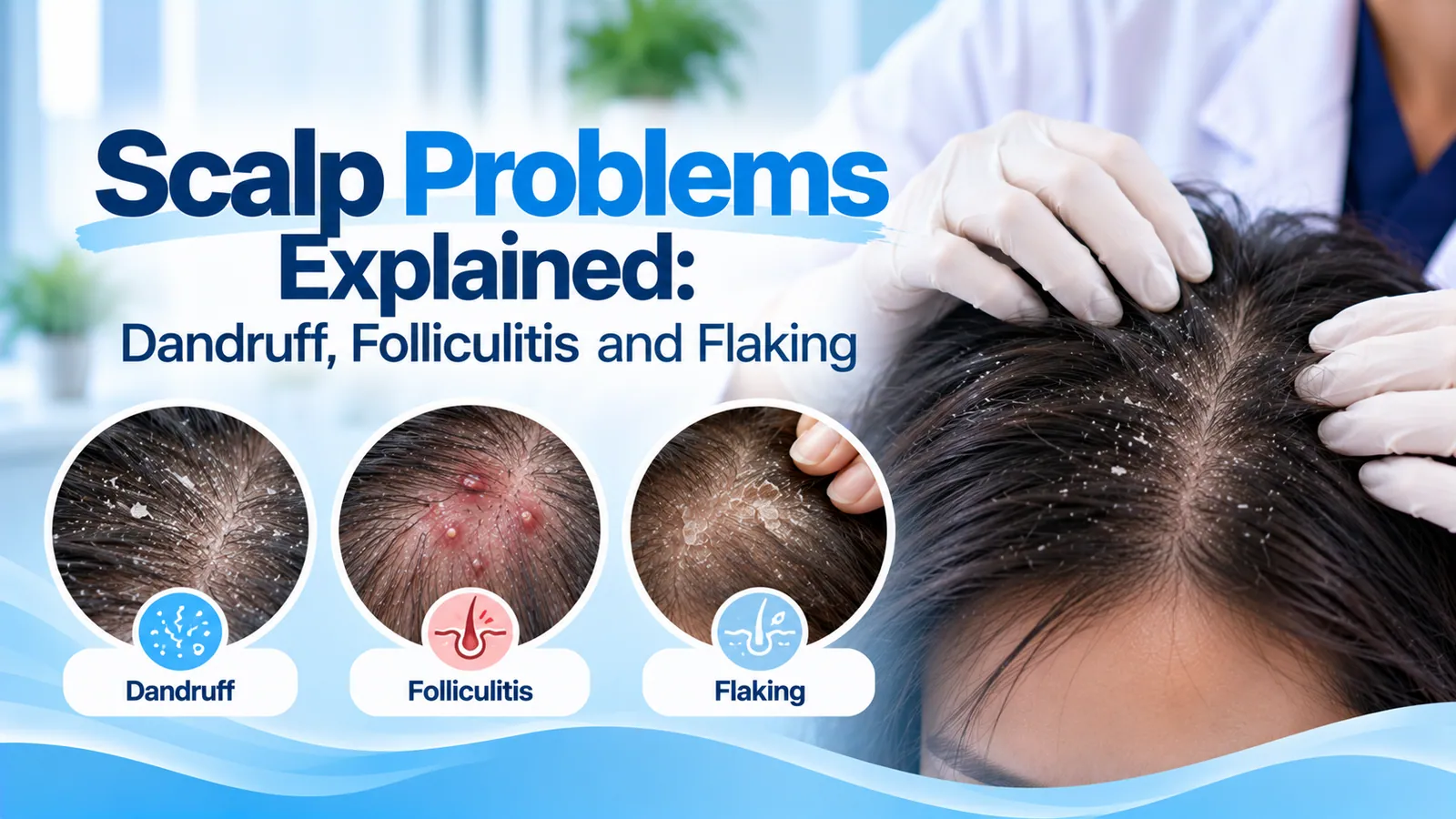
Not every flake is dandruff. The scalp is skin with a very high density of follicles and oil glands, so it develops the same conditions as skin elsewhere. Flaking, itching, pus spots and soreness point to different causes, and each needs a different treatment — which is why the fifth shampoo rarely works better than the first.
The short answer
Fine greasy white-yellow flakes with itch, often also on the eyebrows, sides of the nose and behind the ears, are usually dandruff or seborrhoeic dermatitis. Thick, well-defined silvery plaques crossing the hairline suggest scalp psoriasis. Itchy or tender pus spots around hair follicles suggest folliculitis. Scaly patches with broken hair or bald areas, especially in a child, suggest a fungal infection and need medical assessment.
Ordinary dandruff does not cause permanent hair loss. Untreated inflammatory scalp conditions can — which is why months of shampoo-swapping without a diagnosis is a real risk.
Why "it's just dandruff" is usually the wrong starting point
The scalp has more oil glands and more follicles per square centimetre than almost anywhere else on the body, and spends the day under hair, sweat, helmets and head coverings. That makes it prone to inflammation — and means the symptoms all look much the same from outside. Flaking is the final common pathway for half a dozen unrelated problems. So the useful question is not "which anti-dandruff shampoo?" but "what is inflaming this scalp?" Our scalp treatment page covers how each is managed.
Dandruff and seborrhoeic dermatitis — the same spectrum
Dandruff and seborrhoeic dermatitis are two points on one spectrum, not two diseases. Dandruff is the mild end: fine flaking, some itch. Seborrhoeic dermatitis is the inflamed end: redness, greasier yellowish scale, and spread beyond the scalp.
Both are driven by Malassezia, a yeast living normally on everyone's skin, reacting with scalp oil; the immune response to that oil's breakdown products produces the itch and flaking. It is not caused by poor hygiene. Worth saying plainly, because the shame attached to dandruff is common and simply wrong — over-washing with harsh shampoo often makes it worse.
The giveaway is the distribution. It rarely limits itself to the scalp: look for flaking or redness in the eyebrows, the creases at the sides of the nose, and behind or inside the ears. If those are involved, the scalp flaking almost certainly belongs to the same condition.
Typical pattern
- Fine white to yellowish flakes, slightly greasy rather than dry
- Itch that comes and goes, worse when hot or sweaty
- Eyebrows, sides of the nose and behind the ears often involved
- Flares with stress, heat and humidity
- Improves with treatment, returns if treatment stops entirely
Scalp psoriasis — mistaken for severe dandruff for years
Scalp psoriasis produces thicker, well-defined plaques with a silvery scale, often extending just past the hairline onto the forehead, neck or ears. Unlike seborrhoeic dermatitis the edges are sharp — you can feel where the plaque stops.
It is frequently misread as stubborn dandruff for years, which matters because psoriasis is a long-term inflammatory condition that may also affect the nails, elbows, knees and joints. "Bad dandruff" that never fully responds, with scale you can lift in thick layers, deserves a proper look — see our psoriasis page.
Scalp folliculitis — common, and under-recognised
Scalp folliculitis is inflammation of the follicles themselves, producing itchy or tender bumps and pustules, each centred on a hair. It feels different from dandruff: sore rather than flaky, and worse to the touch.
In Malaysia it is strongly associated with helmet use, trapped sweat and occlusion — hours of a damp, warm, enclosed scalp. It is far more common than the attention it gets, because the flaking alongside it gets blamed on dandruff and treated with the wrong product for months.
Tinea capitis — fungal scalp infection
Tinea capitis causes scaly patches with hair breaking off short, or patchy bald areas, and is seen mainly in children. Two things make it important: it is contagious, spreading between people and sometimes from animals, and it does not clear with shampoo alone — it needs proper medical treatment, assessed and prescribed by a doctor. A child with a scaly patch and hair loss should be checked rather than treated at home, partly for the child and partly to stop it circulating through a household or classroom.
Reactions to hair dye and products
Itch, redness, stinging or swelling that starts within hours to days of a new product points to a contact reaction, not dandruff. Shampoos, styling products, leave-in treatments and especially permanent hair dye can all trigger it, and dye reactions can be dramatic, with swelling of the scalp, forehead and eyelids. The timing is the clue. Stop the product and keep the packaging — that is genuinely useful at a consultation.
Dry scalp and dandruff are not the same thing
A genuinely dry scalp gives small, fine, dry flakes with a tight feeling and no greasiness. Dandruff flakes are larger, oilier and cling together. The distinction matters because the treatments pull in opposite directions: a dry scalp needs gentler, less stripping washing, while seborrhoeic dermatitis needs active treatment of yeast and oil. Treating one as the other is why so many people feel nothing makes a difference.
How to tell scalp conditions apart
| Flake & symptom | Itch | Where | Other clues | Points to |
|---|---|---|---|---|
| Fine white-yellow, greasy | Mild to moderate | Scalp, eyebrows, nose creases, ears | Worse with heat, sweat, stress | Dandruff / seborrhoeic dermatitis |
| Thick silvery plaques, sharp edges | Variable | Crosses the hairline, ears | Nail changes, elbows, knees, joint aches | Scalp psoriasis |
| Bumps and pus spots on hairs | Itchy or tender | Crown, nape, helmet areas | Sweat, helmets, occlusion | Scalp folliculitis |
| Scaly patch, hair broken short | Variable | One or more defined patches | Child, contagious, bald areas | Fungal scalp infection |
| Redness, stinging, swelling | Often intense | Wherever the product touched | Began after a new product or dye | Contact reaction |
| Small dry flakes, tight skin | Mild | Scalp only | No greasiness; dry skin elsewhere | Dry scalp |
Does a scalp problem cause hair loss?
Honest answer: ordinary dandruff does not cause permanent hair loss — but some untreated scalp conditions genuinely can.
With dandruff and seborrhoeic dermatitis, the shedding people notice comes from scratching and inflammation rather than the flaking. Persistent rubbing breaks hair shafts and can push follicles into a temporary shedding phase; density returns once the scalp calms down.
Conditions that inflame the follicle itself are different. Long-standing folliculitis, untreated fungal infection and scarring scalp conditions can damage follicles permanently, and a follicle that scars does not regrow — which is why twelve months of cycling through shampoos without a diagnosis carries a real cost. If you are losing hair alongside scalp symptoms, see our hair loss and scalp treatment pages.
Why scalp problems flare in Malaysian conditions
Heat and humidity keep the scalp warm, damp and oily — exactly what Malassezia thrives in. Several everyday local habits compound it:
- Motorcycle helmets. Trapped sweat under a warm lining is the classic setup for helmet folliculitis — a genuine local pattern, not a theoretical risk. Let hair dry fully before putting the helmet on, air it out rather than leaving it in a hot boot, and clean or replace the lining.
- Head coverings over damp hair. For anyone wearing a hijab or other covering the practical point is simple: make sure hair is dry before covering it, and choose breathable under-layers. Covering is not the problem; covering damp hair is.
- Daily washing with harsh shampoo. Common in the heat, and often counterproductive — stripping the scalp provokes more oil and more irritation, not less.
- Air-conditioning. Moving repeatedly between humid outdoor air and dry cooled air irritates an already inflamed scalp.
How to actually use a medicated shampoo
Almost everyone uses medicated shampoo wrongly, and that alone explains a large share of "nothing works". It is a treatment applied to skin, not a hair wash.
Apply it to the scalp, not the hair
Part the hair and work the product into the skin in sections. The hair lengths are not the problem — treating them wastes the product.
Give it contact time
Leave it on the scalp for several minutes before rinsing. A thirty-second wash-and-rinse gives the active ingredient no time to do anything.
Use it consistently
On the schedule advised, over weeks — not once in desperation when the flaking gets embarrassing.
Keep going after it improves
The yeast and oil do not disappear. Most people need a maintenance routine, sometimes rotating products, rather than stopping the moment the scalp looks clear.
Use lukewarm water
Hot water increases irritation and itch on an inflamed scalp. It feels good at the time and costs you afterwards.
What does not work
Do
- Treat the scalp skin, with contact time
- Give one approach several weeks before judging it
- Continue maintenance after it settles
- Note the pattern — when it flares, and with what
- Get bumps, pain or bald patches looked at
Don't
- Switch shampoo brands endlessly hoping one works
- Scratch or pick the scale off
- Oil a flaky, greasy scalp — it often worsens it
- Use the medicated shampoo only on the hair lengths
- Stop the moment it improves
- Wash with hot water
The oiling point surprises people. Coconut or hair oil on a scalp that is already greasy and flaking feeds the yeast driving seborrhoeic dermatitis and commonly makes it worse. It can suit a genuinely dry scalp — a different problem.
When you need a visit — and when you don't
You probably do not need an appointment for mild, intermittent flaking with a little itch that settles when a medicated shampoo is used correctly. That is reasonable to manage yourself, and most people do. It is worth seeing a doctor when:
- Flaking persists after several weeks of using a medicated shampoo properly
- The scalp is painful, or has bumps and pus spots
- There are bald patches, or hair loss alongside scalp symptoms
- A severe reaction started suddenly after a product or hair dye
- A child has scaly patches with hair loss or hair breaking off
DSH doctors are fully registered medical practitioners, well trained in evidence-based skin healthcare, able to diagnose, treat and manage skin, hair and scalp conditions. A scalp assessment is doctor-led medical treatment: examining the scalp directly, identifying which condition is present, taking a simple scraping or swab where a fungal or bacterial cause is suspected, and setting out a plan with a realistic timeline. Find your nearest location on our Penang clinics page.
Frequently asked questions
Is dandruff the same as seborrhoeic dermatitis?
They sit on the same spectrum. Dandruff is the mild end — fine flaking with some itch. Seborrhoeic dermatitis is the more inflamed end, with redness, greasy yellowish scale and involvement of the eyebrows, sides of the nose and behind the ears. Both are driven by Malassezia yeast interacting with scalp oil, not by poor hygiene.
Does dandruff cause hair loss?
Ordinary dandruff does not cause permanent hair loss. Scratching and inflammation can cause temporary shedding and breakage, which recovers once the scalp settles. Untreated inflammatory conditions — long-standing folliculitis, fungal infection and scarring scalp conditions — genuinely can cause lasting loss, which is why months of new shampoos without a diagnosis carries real risk.
Why does my scalp flake more in Malaysia's weather?
Heat and humidity increase scalp sweat and oil, which is what Malassezia feeds on, so seborrhoeic dermatitis commonly flares. Helmets, head coverings worn over damp hair, and moving repeatedly between humid outdoor air and air-conditioning all add occlusion and irritation.
How should medicated shampoo be used?
Apply it to the scalp itself, not the hair lengths. Work it into the skin, leave it in contact for several minutes before rinsing, and use it consistently on the schedule advised rather than once in desperation. Most importantly, continue a maintenance routine after the flaking settles instead of stopping immediately, because the yeast and oil that drive it do not go away.
What causes bumps and pus spots on the scalp?
Itchy or tender pustules centred on hair follicles usually indicate scalp folliculitis, strongly associated in Malaysia with helmet use, trapped sweat and occlusion. It is common, often mistaken for stubborn dandruff, and needs treatment aimed at the follicles rather than a scale-reducing shampoo.
Is a fungal scalp infection contagious?
Yes. Tinea capitis spreads between people and sometimes from animals, and is seen mainly in children. It typically causes scaly patches with hair breakage or bald areas. It does not clear with shampoo alone and requires proper medical treatment, so a child with scaly patches and hair loss should be assessed rather than treated at home.
When do I not need to see a doctor about a flaky scalp?
Mild, intermittent flaking with a little itch that settles when an over-the-counter medicated shampoo is used correctly can reasonably be self-managed. See a doctor if flaking persists despite several weeks of correct use, if the scalp is painful or has pus spots, if there are bald patches or hair loss alongside scalp symptoms, if a reaction began suddenly after a product, or if a child has scaly patches with hair loss.
Still flaking after months of shampoo?
Doctor-led medical treatment for scalp and hair conditions — dandruff, seborrhoeic dermatitis, folliculitis, psoriasis and hair loss. No referral needed.
Scalp treatmentContact us