
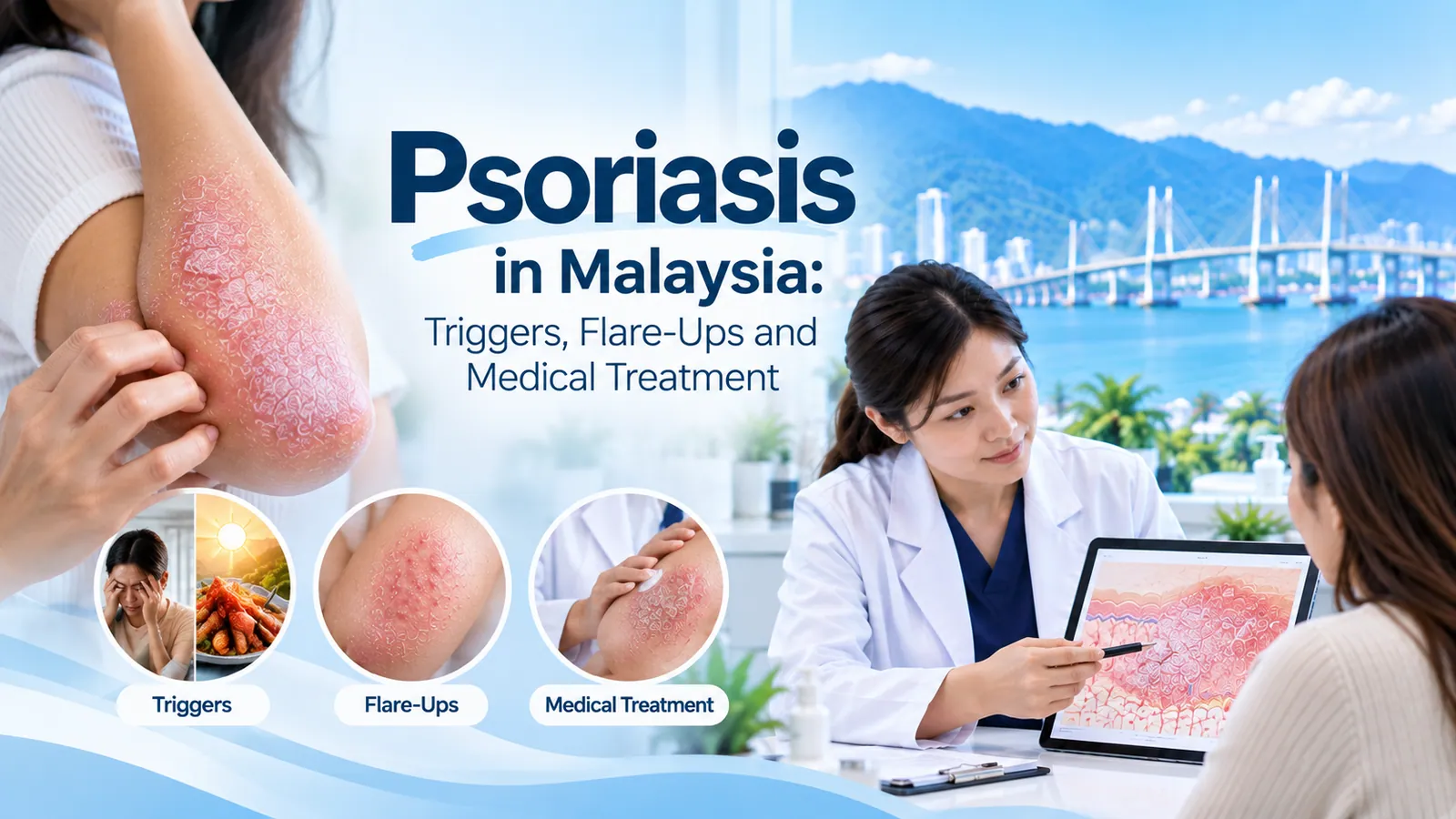
Psoriasis is an immune-mediated condition in which skin cells are produced faster than the body can shed them, so they pile up as thick, scaly plaques. It is not an infection, it cannot be passed between people, and it is controlled rather than cured. In Malaysia, heat, sweat and air-conditioning all shape how it behaves.
The short answer
Psoriasis is the immune system driving skin cells to turn over too quickly. Normal skin renews over roughly a month; in a plaque it happens in days, so cells accumulate as raised patches with silvery scale.
It is not contagious and not an infection. It is a long-term condition that is controlled, not cured — long stretches of clear or near-clear skin are a realistic goal, a permanent cure is not.
What psoriasis actually is
Immune signalling tells the skin to renew far faster than normal: instead of shedding invisibly over three to four weeks, cells reach the surface in days and stack up. That is why a plaque looks as it does — raised, thickened, firmly attached silvery-white scale over a red or darker base, with a clear border where it stops and normal skin begins. On deeper skin tones that base often reads violet, brown or greyish rather than bright red, one reason psoriasis is missed locally. There is usually a genetic tendency behind it, which an infection, stress, a skin injury or a new medication then tips into a flare.
Psoriasis is not contagious — and it is controlled, not cured
You cannot catch psoriasis from another person, and you cannot give it to anyone. Not by touch, not by sharing a towel or a prayer mat, not through a swimming pool, not by eating from the same plate. It is not fungal, bacterial or viral, and not a sign of being unclean. Yet people with visible plaques are routinely asked to cover up or stop handling food — pressure that leads many to conceal affected skin in a tropical climate, trapping heat and sweat, and to delay getting assessed at all.
Key points
- Immune-mediated, not infectious.
- Cannot be transmitted to or from another person by any route.
- Not caused by poor hygiene or anything the person did wrong.
- Long-term but controllable — most people reach comfortable, settled skin.
- Covering plaques tightly in heat and humidity makes them worse.
It is controlled, not cured
No treatment permanently removes psoriasis, and anything claiming to cure it is not being honest with you. The immune tendency stays. What treatment does well is calm inflammation, thin plaques, lift scale, settle itch and keep things quiet for long stretches. The realistic goal is control: fewer, milder flares and faster recovery.
The common types, described so you can recognise yours
Psoriasis does not look the same on everyone. These are the patterns seen most often.
Plaque psoriasis — the most common
Thick, well-defined patches with silvery scale on the outside of the elbows and knees, the lower back and the scalp, often symmetrical. They may itch, feel tight, and crack or bleed when skin is dry.
Scalp psoriasis
Thickened, scaly plaques along the hairline, behind the ears and at the back of the head. The scale is firmly stuck down and silvery, unlike the looser, greasier flaking of ordinary dandruff.
Guttate psoriasis
Many small, drop-like spots appearing suddenly on the trunk and limbs, classically a week or two after a throat infection, and more often in younger people. It often settles once the trigger passes.
Inverse (flexural) psoriasis
Smooth, shiny, well-defined red patches in skin folds — groin, under the breasts, armpits. Friction and sweat rub the scale away, so in a humid climate it is very often assumed to be fungal and treated with antifungal cream that does nothing.
Nail involvement
Pitting of the nail surface, thickening, crumbling, or the nail lifting from the nail bed. Easily dismissed as nail fungus, and a useful clue when skin findings are unclear.
Psoriasis or eczema? How to tell them apart
The quickest distinction is the edge and the surface: psoriasis is thicker, sharply bordered and silvery-scaled; eczema is vaguer at the edges, often weepy, and dominated by itch. Sites differ too — psoriasis prefers the outside of joints, eczema the inside.
| Feature | Psoriasis | Eczema |
|---|---|---|
| Thickness | Thick, raised, firm plaques | Thinner, often flat or slightly swollen |
| Border | Well defined — you see where it stops | Poorly defined, fading into normal skin |
| Surface | Dry silvery-white scale, firmly attached | Often weepy or crusted; fine flaking |
| Usual sites | Extensor — outside of elbows and knees, lower back, scalp, nails | Flexural — inside of elbows and knees, wrists, neck, eyelids |
| Dominant symptom | Tightness, soreness, cracking; itch variable | Itch, usually intense and the main complaint |
| Nail changes | Pitting, thickening, lifting from the nail bed | Uncommon |
These patterns overlap and the two can coexist, so a table narrows the possibilities without replacing an examination. Read how each is managed on our psoriasis treatment and eczema treatment pages.
What triggers a psoriasis flare-up in Malaysia?
Flares are set off by things that stress the immune system or injure the skin. The general triggers are well established; the local climate adds its own.
General triggers
- Stress — workload, exams, bereavement, poor sleep. The most consistently reported trigger.
- Throat infections — a sore throat can precede a guttate flare by one to two weeks.
- Skin injury (the Koebner phenomenon) — new plaques appearing exactly where skin was scratched, cut, shaved, tattooed, rubbed by a strap or sunburnt. This is why picking at plaques is self-defeating.
- Certain medications — some drugs for blood pressure, mood or malaria, and withdrawal of oral steroids. Never stop prescribed medication yourself; raise it with your doctor.
- Smoking and alcohol — both linked with more severe disease and poorer treatment response.
The local triggers that get missed
- Heat and sweat — irritates plaques, stings cracked skin, and drives inverse psoriasis in the groin, under the breasts and armpits. Loose cotton and drying folds properly genuinely help.
- Air-conditioning — long office or in-car hours in dry, cold air strip moisture from skin, thickening scale and cracking plaques. Emollients matter as much here as in a cold country.
- Mislabelled as fungal — many patients arrive having used antifungal creams for months with no change, because the problem was never fungal, while the plaques thickened meanwhile.
- Covering up in the heat — tight or synthetic layers trap sweat against inflamed skin and worsen it.
How psoriasis is treated medically
Treatment is non-laser, non-aesthetic medical skin care resting on three things: a constant emollient foundation, prescribed topical treatment to calm inflammation and lift scale, and regular review so the plan changes as the skin does. How it is applied and stepped down matters as much as what is prescribed.
Emollients as the constant foundation
Generous, frequent moisturising never stops, flare or no flare. Emollients soften and gradually lift scale, reduce cracking and itch, and let prescribed treatment reach the skin underneath.
Topical treatment for inflammation and scale
Chosen for the type of psoriasis, the body site and the plaque thickness — scalp, face and skin folds are handled differently from an elbow. Some preparations calm inflammation; others break down scale so the rest can work.
Careful tapering, not abrupt stopping
Stopping the moment skin looks clear is a leading reason psoriasis rebounds. Treatment is stepped down gradually on a planned schedule, with emollients continuing throughout.
Targeted occlusion for stubborn plaques
Thick plaques can resist treatment because nothing penetrates them. Covering a treated area for a defined period softens scale and improves absorption — on selected sites only, and only on a doctor's instruction.
Continuous follow-up and adjustment
Psoriasis shifts with stress, season and time, so last year's plan may not fit this year. Reviews check what improved, whether the plan is workable in practice, and whether scalp, nails or joints need attention.
Where psoriasis is widespread, severe or not responding, your doctor discusses the appropriate next step. No one should be left applying something that is not working.
What to realistically expect, and when
Psoriasis improves over weeks, not days, and the scalp and nails are slowest to respond. Knowing the honest timeline stops people abandoning treatment just as it starts working.
| Timeframe | What is reasonable to expect |
|---|---|
| First 1–2 weeks | Scale softens, cracking and soreness ease, itch starts to settle. Plaques still clearly visible. |
| 2–6 weeks | Plaques flatten and thin noticeably — the stage where real change shows. |
| 6–12 weeks | Many plaques are flat, leaving a darker or lighter mark. That discolouration is not active psoriasis and fades slowly over months. |
| Scalp psoriasis | Slower than body skin: scale and hair both limit how well treatment reaches the surface. |
| Nail psoriasis | Slowest of all. Nails grow slowly, so change is judged over several months. |
| Long term | Flares still happen. Well-managed psoriasis means fewer, milder, faster-settling ones. |
Flat, discoloured marks left behind are a sign treatment worked, not that it failed — they are often mistaken for active psoriasis and lead people to escalate treatment unnecessarily.
What does not work — and what makes it worse
Several widely tried approaches waste time, and some provoke new plaques.
Do
- Apply emollient generously and often, flare or not
- Let scale soften and lift on its own with treatment
- Wear loose cotton; dry skin folds properly
- Follow the step-down plan you were given
- Mention scalp, nail and joint symptoms, however minor
- Take sore throats, stress and sleep seriously
Don't
- Scrub, pick or peel off scale — injury creates new plaques
- Keep using antifungal cream on a condition that is not fungal
- Stop treatment the moment the skin looks better
- Use unregulated “detox” or whitening products on plaques
- Buy strong creams on someone else's recommendation
- Scratch an itchy patch instead of treating the itch
The scrubbing point deserves emphasis: injured skin can grow a brand-new plaque exactly where it was damaged, so peeling scale off reliably makes psoriasis worse.
Psoriasis is not only a skin condition
Psoriasis is associated with other health conditions, most notably psoriatic arthritis. This causes joint pain, swelling and stiffness — characteristically worst in the morning or after sitting still, easing with movement — and it does not always track how bad the skin looks.
That is not a reason to worry; it is a reason to mention it. If you have skin plaques and also joint pain or morning stiffness, tell your doctor about the joints at the same visit — they are easily left unsaid when the appointment is “about the skin”. Psoriasis is also linked with cardiovascular and metabolic health, so general health checks matter alongside treating plaques.
When you need a visit — and when you do not
Not every patch needs an appointment, and saying so is part of honest advice.
A visit is probably not needed yet if
- A small, familiar, comfortable patch is responding to the plan you already have
- Only mild dryness or flaking remains and emollient manages it
- You are weeks into a plan and it is slowly improving
Arrange a visit if
- Patches are spreading, thickening, cracking or bleeding, or the scalp, nails, face, genitals or skin folds are involved
- You have joint pain, swelling or morning stiffness
- Itch or soreness is disturbing sleep or daily life
- An antifungal or over-the-counter cream has run for weeks with no change
- Spots appeared suddenly and widely, especially after a sore throat
- Skin becomes hot, painful, weeping or crusted, you develop a fever, or very extensive redness or widespread skin shedding develops — seek medical care promptly
DSH provides non-laser, non-aesthetic medical treatment for skin, hair and scalp conditions across Penang, Kedah and Perak. DSH doctors are fully registered medical practitioners, well trained in evidence-based skin healthcare, able to manage conditions such as psoriasis over the long term. No referral is required — see our Penang locations or get in touch.
Frequently asked questions
Is psoriasis contagious?
No. Psoriasis is an immune-mediated condition, not an infection. It cannot be caught from another person, passed on by touch, shared towels, swimming pools or sharing food, and it is not a sign of poor hygiene.
Can psoriasis be cured?
No. Psoriasis is a long-term condition that is controlled rather than cured. With consistent treatment and follow-up, long periods of clear or near-clear skin are a realistic goal, but the underlying tendency remains and flares can return.
How is psoriasis different from eczema?
Psoriasis plaques are thicker, have well-defined edges, carry a silvery scale and favour extensor surfaces such as the outside of the elbows and knees, the lower back and the scalp. Eczema is less clearly bordered, often weepy or crusted, favours flexural areas such as the inside of the elbows and knees, and itch is usually the dominant symptom.
What triggers a psoriasis flare-up?
Common triggers include stress, throat infections, injury to the skin such as scratching, cuts or sunburn, certain medications, smoking and alcohol. In Malaysia, heat and sweat commonly irritate plaques and worsen psoriasis in skin folds, while long hours in air-conditioning dry the skin and increase scaling.
Why do antifungal creams not help my psoriasis?
Because psoriasis is not a fungal infection. Smooth red patches in the groin, under the breasts or in the armpits are often assumed to be fungal in a humid climate, so antifungal creams are tried first and have no effect. An in-person examination is needed to tell the two apart.
Does psoriasis affect anything other than the skin?
It can. Psoriasis is associated with other health conditions, most notably psoriatic arthritis, which causes joint pain and stiffness that is often worst in the morning. Anyone with skin plaques and joint symptoms should mention the joints to their doctor so both are assessed.
When do I not need to see a doctor about psoriasis?
A small, stable, known patch that is comfortable and controlled with your usual emollient and prescribed treatment can reasonably be managed at home. Arrange a review if it is spreading, cracking or bleeding, involves the scalp, nails, face or skin folds, disturbs sleep, comes with joint pain, or has not improved after a few weeks of treatment.
Get your psoriasis properly assessed
Doctor-led, non-laser, non-aesthetic medical skin care for psoriasis, eczema, acne and more. No referral needed.
Psoriasis treatmentContact us