
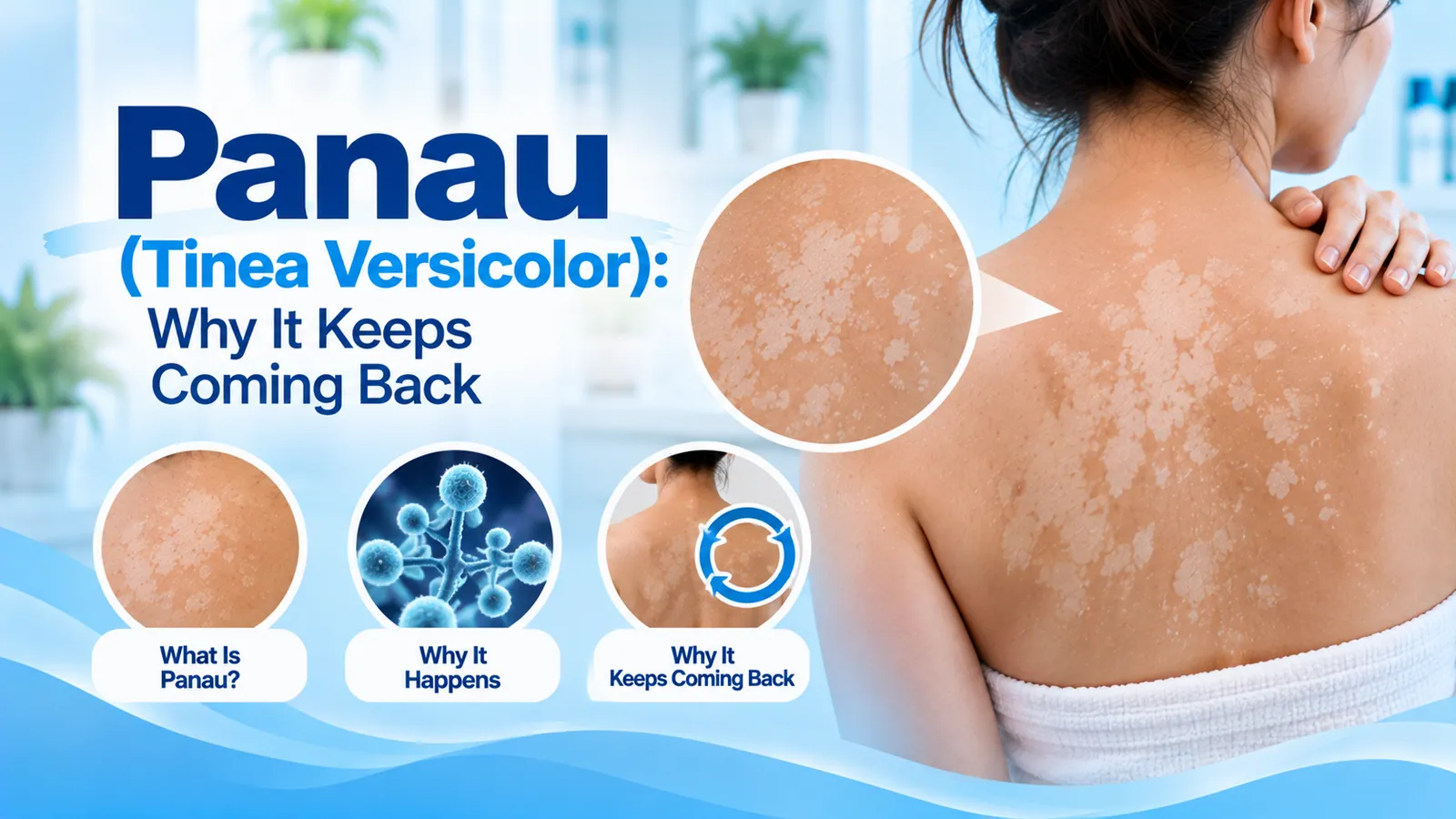
Panau — medically tinea versicolor, or pityriasis versicolor — keeps coming back because the yeast behind it is a permanent, normal resident of human skin. Treatment reduces the overgrowth; it cannot evict a microbe that belongs there. In Malaysia's year-round heat and humidity the conditions that let it overgrow never really go away, so panau is controlled and maintained rather than cleared once and forgotten.
The short answer
The pale patches stay for weeks to months after the yeast has already been treated successfully. The yeast interferes with pigment production, and pigment cells need time to recover — so colour is always the last thing to return.
Judge treatment by whether the scaling and itch have stopped and no new patches are appearing — not by whether the colour has evened out. Many people conclude treatment failed, stop too early, or keep re-treating skin that is already clear of yeast.
What panau actually is — and what it is not
Panau is a superficial overgrowth of Malassezia, a yeast that lives harmlessly on almost everyone's skin and feeds on skin oil. When heat, sweat and oil give it the right conditions, it multiplies beyond its usual numbers and becomes visible as patches. Two things it is not, and both cause real and unnecessary embarrassment:
- It is not contagious. You did not catch it from a shared towel, bed or changing room. The yeast is already on the other person's skin too — it simply has not overgrown there.
- It is not a sign of poor hygiene. People with panau are often the ones showering two or three times a day. Washing more does not prevent it: the problem is oil, sweat and warmth, not dirt.
It sits in the oiliest areas — chest, upper back, shoulders, neck and upper arms. That distribution, rather than any test, usually makes the diagnosis obvious.
Why the patches look pale (or dark, or pink)
The yeast produces a substance that interferes with pigment production in the skin underneath it, so those patches stop tanning along with everything around them. Spend a weekend outdoors and the surrounding skin darkens while the patches do not — the contrast becomes more obvious after sun exposure, not less.
The appearance varies, which is why the medical name includes versicolor:
- Lighter than surrounding skin — the commonest presentation, and the one people call panau.
- Darker or light brown — equally possible, and often mistaken for ordinary pigmentation.
- Faintly pink — usually when active and mildly inflamed.
The patches are flat, with a slightly irregular edge, often merging into larger areas, and release a fine powdery scale if you scratch lightly across them. Itch is usually mild, and worse when sweating.
Why the colour lags months behind treatment
This is the most useful thing to understand about panau, and the reason most people believe their treatment failed.
The real timeline
- Days to 2 weeks: scaling settles, itch stops, patches stop spreading — the overgrowth is coming under control.
- 2 to 4 weeks: no new patches appear. This — not colour — is the marker that treatment has worked.
- 1 to 6 months: pigment cells gradually resume normal production and the patches slowly blend back in.
- Longer with heavy sun exposure, because tanned surrounding skin keeps the contrast visible.
Pigment recovery is a repair process and cannot be hurried. A patch still visibly pale at six weeks is not evidence of failure, and not a reason to restart treatment. What matters is whether it is still scaling and whether new patches are forming.
Why panau genuinely recurs
Recurrence is regrowth, not reinfection. Because Malassezia never leaves the skin, successful treatment returns it to normal numbers rather than removing it. Whenever heat, humidity, sweat and skin oil combine again, it can overgrow again.
In temperate countries panau is largely a summer problem. In Malaysia there is no off-season — humidity and heat are constant and most people sweat daily. Recurrence rates are high everywhere; in this climate, higher still. Panau is best understood as a condition that is controlled and managed, not cured once.
Who gets panau more often?
Panau favours skin that produces more oil and sweats more:
- Adolescents and young adults — peak oil production, and the commonest age group by far.
- People who sweat heavily, from activity, build or physiology.
- Outdoor and physical workers — construction, delivery, kitchen, security.
- Athletes and gym-goers who stay in damp kit after training.
- Anyone using oily body products on the chest and back.
How to break the cycle
The step that changes outcomes is maintenance treatment during the sweatiest periods, rather than waiting for patches to reappear and then treating them. Everything else helps, but is secondary.
Maintenance means applying an antifungal treatment intermittently, on a planned schedule agreed with your doctor, through the periods when you sweat most — keeping the yeast at normal numbers instead of letting it climb back to visible levels. Because it prevents the overgrowth rather than chasing it, it is what breaks the clear-recur-clear cycle. The right product, schedule and duration depend on how extensive and frequent your panau is, which is a consultation decision rather than a web-page one.
Do
- Shower soon after sweating and dry the chest, back and neck thoroughly.
- Change out of damp clothing promptly rather than letting it dry on you.
- Choose loose, breathable cotton over synthetic tops in the heat.
- Keep heavy oils and thick lotions off the chest, back and shoulders.
- Use a maintenance plan through your sweatiest months, as advised.
- Complete the full course even once the scaling has settled.
Don't
- Use whitening or lightening creams to even out the patches.
- Scrub or exfoliate the patches to remove the colour.
- Sunbathe to tan the pale areas — it worsens the contrast.
- Stop treatment the moment scaling improves.
- Apply steroid creams, which can let it spread further.
- Restart treatment just because the colour is still uneven.
What does not work on panau
Treatments aimed at the colour do nothing, because the colour is a consequence rather than the condition.
Whitening and lightening creams target pigment, not the yeast, so the overgrowth continues underneath — and unregulated lightening products sold in Malaysia have repeatedly been found to contain undeclared mercury or potent steroids, genuinely harmful over large areas like the chest and back. Scrubbing flattens patches for a day, irritates affected skin and does not reduce the yeast. Sunbathing fails because the patches cannot tan while the surrounding skin can, leaving sharper contrast and sun damage. Steroid creams may briefly settle redness and itch, which feels like progress, but can allow a fungal skin infection to spread more widely.
Other conditions that cause pale patches
Not every pale patch is panau, and a few look similar enough to be worth checking before months of self-treatment.
| Condition | How it differs from panau |
|---|---|
| Panau (tinea versicolor) | Off-colour rather than fully white, faintly scaly when scratched, on chest, back, shoulders and neck, improves with antifungal treatment. |
| Vitiligo | Completely milk-white, sharply defined, no scale, often around the eyes, mouth or hands, and does not respond to antifungal treatment. |
| Pityriasis alba | Faint pale patches on children's faces, often alongside eczema or dry skin. |
| Post-inflammatory hypopigmentation | Pale marks exactly where a previous rash, spot or injury sat — the shape matches it. |
| Leprosy-related patches | Uncommon in Malaysia but still seen; patches may have reduced or absent sensation. Any numb pale patch needs proper assessment rather than self-treatment. |
That last row is not a reason for alarm — it is simply why a persistent pale patch with any loss of feeling should be examined rather than treated from a pharmacy shelf.
When you need a visit — and when you do not
A small, typical patch that settles with an over-the-counter antifungal is reasonable to manage yourself. If the scaling stops, the itch goes and nothing new appears, you have done what treatment can do — the colour will catch up on its own. See a doctor if:
- The patches are widespread, or keep returning after every course.
- You are not certain it is panau rather than something else.
- Any patch has numbness or reduced sensation.
- Scaling or itch has not improved after a properly completed course.
- The patches are on a child.
At DSH, panau is handled as non-laser, non-aesthetic medical skin care: confirming the diagnosis by examination, treating the overgrowth, and — the part most often missing — setting up a maintenance plan with follow-up so the cycle actually breaks. Our doctors are fully registered medical practitioners, well trained in evidence-based skin healthcare. Locations are listed on our medical skin treatment in Penang page.
Frequently asked questions
Why does my panau keep coming back?
Because the yeast behind it, Malassezia, is a permanent normal resident of everyone's skin. Treatment returns it to normal numbers rather than removing it, so whenever heat, sweat and skin oil combine again it can overgrow again. In Malaysia those conditions are present all year. A maintenance plan through your sweatiest periods is what reduces recurrence.
How long do the white patches take to go away?
Usually one to six months after the yeast has been treated, because pigment cells need time to recover. It takes longer if you are often in the sun, since the surrounding skin keeps tanning while the patches cannot.
How do I know the treatment worked?
The scaling and itch stop, and no new patches appear. Colour is not a marker — it evens out well after the yeast is controlled, so pale patches alone do not mean treatment failed or needs repeating.
Is panau contagious?
No. The yeast is already present on virtually everyone's skin, so there is nothing to catch — and it is not a sign of poor hygiene.
Will whitening cream help panau?
No. It targets pigment rather than the yeast, so the overgrowth continues underneath. Unregulated lightening products sold in Malaysia have also been found to contain undeclared mercury or potent steroids, genuinely harmful over large areas such as the chest and back.
Can panau be cured permanently?
It can be controlled very well, but not permanently removed, because the yeast is part of normal skin. Managed with maintenance, episodes become far fewer and milder.
Is it panau or vitiligo?
Vitiligo patches are completely milk-white with sharp borders and no scale, and do not respond to antifungal treatment. Panau is off-colour rather than fully white, faintly scaly when scratched, and sits mainly on the chest, back, shoulders and neck. Any pale patch that feels numb should be examined.
Panau that keeps coming back?
Doctor-led, non-laser, non-aesthetic medical skin care — diagnosis confirmed, overgrowth treated, and a maintenance plan with follow-up. No referral needed.
Find your Penang clinicContact us