
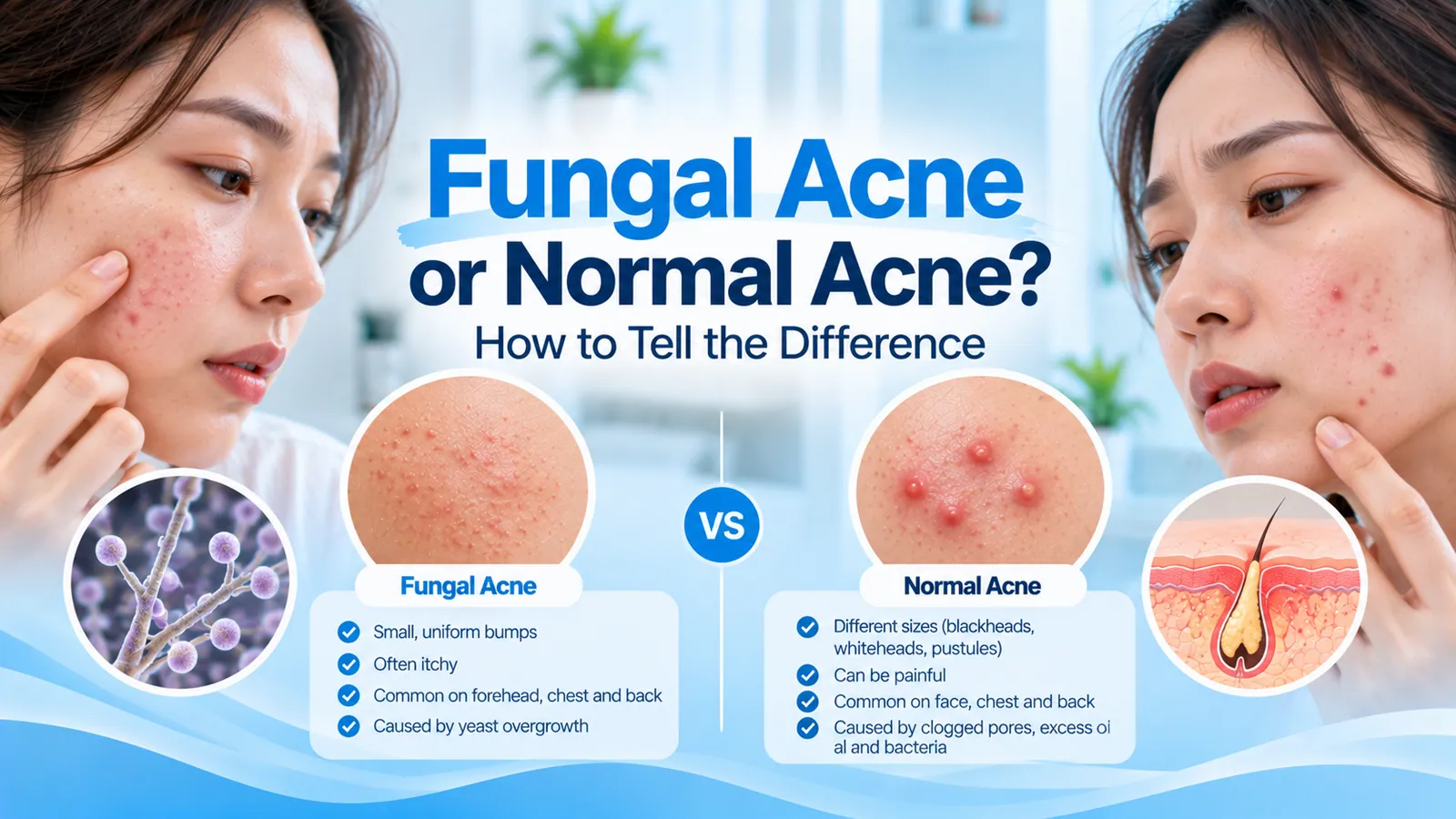
The single most useful fact about fungal acne is that it is not acne. The accurate name is Malassezia folliculitis — an overgrowth of a yeast that already lives on everyone's skin, inflaming the hair follicles. Because the cause is completely different, acne treatments do not clear it. That is why so many people fight it for months without getting anywhere.
The short answer
"Fungal acne" is Malassezia folliculitis (also called pityrosporum folliculitis): yeast inflaming hair follicles. It shows as many small bumps, all about the same size, often itchy, on the forehead, chest, upper back and shoulders — and no blackheads or whiteheads.
Acne has mixed lesion sizes, includes blackheads and whiteheads, sits mainly on the face and jawline, and is usually not itchy. The two often coexist, which is exactly what makes it confusing.
Why "fungal acne" is not acne at all
Malassezia lives harmlessly in the follicles of almost every adult, feeding on the oils on the skin surface. It becomes a problem only when conditions let it multiply beyond its usual numbers — warmth, moisture, trapped sweat, extra oil. When it overgrows inside a follicle, that follicle inflames, and the result is a crop of small, red, dome-shaped bumps.
Real acne starts somewhere else entirely: a pore blocked by dead skin cells and oil, with hormonal drive behind it and a different organism involved. That is why the lesions look different, sit in different places, and respond to different treatment.
This distinction is not pedantry. It is why someone can follow a well-chosen acne routine properly for three months, see nothing change, and conclude their skin is "resistant" — when the treatment was aimed at the wrong target all along.
How to tell fungal folliculitis from acne
Most cases can be separated by four things: how uniform the bumps are, whether they itch, where they are, and whether blackheads are present.
| Feature | Malassezia folliculitis ("fungal acne") | Acne |
|---|---|---|
| Size and shape | Many small bumps, all roughly the same size, uniform and monotonous | Mixed sizes — small spots alongside larger, deeper lesions |
| Blackheads / whiteheads | Absent | Present — a defining feature |
| Itch | Often itchy, sometimes intensely so | Usually not itchy; may be tender or sore |
| Where it appears | Forehead and hairline, chest, upper back, shoulders, upper arms | Mainly the face, especially the lower face and jawline |
| What sets it off | Sweating, heat, humidity, occlusive sunscreen, tight gym clothing, a recent course of antibiotics | Hormonal cycles, oil production, friction and picking |
| Response to acne treatment | No improvement, or clearly worse | Gradual improvement over 6–12 weeks |
An honest caveat: the two frequently coexist. Plenty of people have genuine acne on the jawline and Malassezia folliculitis across the forehead and upper back at the same time. In that situation a single treatment aimed at either one alone will only ever half-work, which is one of the most common reasons long-standing "acne" never fully settles.
The most telling clue: skin that got worse on antibiotics
If an oral antibiotic prescribed for acne made your skin worse rather than better, that is a strong pointer towards Malassezia.
The mechanism is straightforward. The skin surface is a crowded ecosystem, and the bacteria there compete with the yeast for space and food. Reduce the bacteria and the yeast flourishes. A treatment that genuinely helps acne can therefore drive a fungal folliculitis in the same person — and because the new bumps look vaguely acne-like, they are often misread as the acne "flaring" and met with more of the same.
Key points
- Uniform, itchy bumps with no blackheads are rarely acne.
- Forehead, chest, upper back and shoulders are the classic distribution.
- Getting worse on antibiotic acne treatment is a meaningful clue, not a coincidence.
- Flares follow sweat, heat, humidity and occlusion — not hormones.
- Acne and fungal folliculitis commonly occur together in the same person.
Why this is far more common in Malaysia
Malassezia needs warmth and moisture, and Malaysia supplies both every single day of the year. Most information written about this condition comes from temperate countries, where it is treated as an occasional summer problem. Here it is a year-round one.
- Constant humidity. Sweat does not evaporate efficiently in high humidity, so skin stays damp for far longer than it would in a dry climate.
- Motorcycle commutes. A helmet traps heat and sweat against the forehead and hairline twice a day — which is precisely where the forehead crop so often appears.
- Sweat under clothing. Work shirts, backpacks and bra straps hold moisture against the upper back and shoulders for hours.
- Air-conditioning cycling. Moving repeatedly between chilled indoor air and outdoor heat means repeated sweating and drying through the day.
- Sport and gym in high humidity. Heavy sweating followed by sitting around in damp clothing is one of the most reliable triggers we see.
- Heavy sunscreen and rich creams applied over skin that is about to sweat add a layer of occlusion on top of all of the above.
What actually helps at home
Sensible sweat and occlusion management genuinely reduces flares, and it is worth doing whether or not you also need treatment. What it will not usually do is clear an established case on its own.
Do
- Shower and change promptly after sweating, rather than hours later.
- Get out of damp gym or work clothes as soon as you can.
- Choose loose, breathable fabrics over tight synthetics on the chest and back.
- Keep products on affected areas light and non-greasy.
- Wipe or wash the forehead and hairline after a helmet or a cap.
- Take photos of a bad week — it helps a doctor see the real pattern.
Don't
- Sit around in sweaty clothing because the shower can wait.
- Layer heavy occlusive oils or rich creams over affected areas.
- Scrub the bumps — friction inflames follicles further.
- Pick or squeeze; there is nothing to extract.
- Keep pushing an acne routine that has clearly not worked for months.
- Strip your skin barrier with harsh washing in the hope of drying it out.
What does not work, and why
Most of the frustration around this condition comes from treatments that are perfectly reasonable for acne and simply irrelevant to yeast.
- Benzoyl peroxide and standard acne treatments. They act on blocked pores and acne bacteria. Wrong target. They may help a coexisting acne component, but they do not clear Malassezia folliculitis.
- Oral antibiotics. As above — they can actively make it worse by removing the bacteria that keep the yeast in check.
- Rich moisturisers and many facial oils. Several common oils and fatty ingredients are exactly what this yeast feeds on, so applying them to affected areas can prolong a flare.
- Aggressive scrubbing and exfoliating. This is follicular inflammation, not a surface blockage. Mechanical irritation makes inflamed follicles angrier.
- Self-diagnosing from an ingredient-checker website. Someone decides online that they have fungal acne, then permanently avoids dozens of flagged ingredients — while the diagnosis is never confirmed and the condition never treated. Avoiding heavy occlusives on affected skin is reasonable; a lifelong blacklist from a website is not.
Why it keeps coming back
It recurs because the yeast never leaves — and it is not supposed to. Malassezia is a normal resident of healthy skin. Treatment reduces an overgrowth; it does not and cannot sterilise the skin permanently.
That reframes what success looks like. The realistic goal is control and prevention of flares, not permanent eradication. A flare settles, and then the job becomes keeping the conditions that caused it from rebuilding — which in a humid climate means the sweat habits above, applied steadily, plus whatever maintenance approach a doctor advises for your pattern.
When to see a doctor — and when you need not
You do not need an appointment for every crop of bumps. A few small spots after a sweaty, unusually humid week, which settle within days once you shower promptly, get out of damp clothes and stop putting heavy cream on the area, can simply be watched.
It is worth being assessed when it is widespread, itchy enough to disturb sleep, has lasted more than a few weeks, keeps returning in the same places, or has not responded to acne treatment — particularly if it worsened on antibiotics.
The value of an assessment is mainly diagnostic. Several conditions produce small bumps that look alike from a distance: Malassezia folliculitis, bacterial folliculitis, genuine acne and friction irritation. They need different management, and a close examination — with a simple in-clinic test where the picture is unclear — is what separates them. DSH doctors are fully registered medical practitioners, well trained in evidence-based skin healthcare, providing non-laser, non-aesthetic medical skin care. Where both conditions are running together, the plan has to address both.
You can read more about how we assess medical skin treatment, or about ongoing care at our Penang locations.
Frequently asked questions
Is fungal acne really acne?
No. The accurate name is Malassezia folliculitis, also called pityrosporum folliculitis. It is an overgrowth of a yeast that normally lives on everyone's skin, which inflames the hair follicles. Because it is not acne, acne treatments do not clear it — which is why people struggle with it for months.
How do I know if my bumps are fungal or normal acne?
Malassezia folliculitis usually appears as many small bumps all roughly the same size, often itchy, clustered on the forehead, chest, upper back and shoulders, with no blackheads or whiteheads. Acne has mixed lesion sizes, includes blackheads and whiteheads, sits mainly on the face and jawline, and is usually not itchy. The two commonly occur together.
Why did my skin get worse on antibiotics for acne?
This is one of the most telling clues. Antibiotics reduce the bacteria that normally compete with Malassezia on the skin, so the yeast can flourish. Skin that worsened rather than improved on an antibiotic acne treatment should be reassessed.
Is this more common in Malaysia?
Yes. Malassezia thrives in heat, humidity and sweat, all of which are constant here. Motorcycle commutes and helmets, sport in high humidity, sweat trapped under clothing, and daily cycling between air-conditioning and outdoor heat all favour it, so it is seen far more often than in temperate countries.
Does benzoyl peroxide work on fungal acne?
Generally no, because it targets the wrong problem. Benzoyl peroxide and most standard acne treatments are aimed at acne bacteria and blocked pores, not at yeast inside the follicle. They may help a coexisting acne component but will not clear Malassezia folliculitis.
Can it be cleared permanently?
No. Malassezia is a normal resident of healthy skin and cannot be eliminated for good. The realistic aim is control — settling the current flare, then preventing the next one through sweat management and maintenance. Recurrence is common in a humid climate.
Should I use an online ingredient checker to avoid triggers?
Use it with caution. Ingredient-checker sites commonly flag dozens of ingredients on theoretical grounds, which leads people to restrict their skincare drastically while the underlying condition is never confirmed or treated. Avoiding heavy occlusive oils and rich creams on affected areas is sensible; building a permanent blacklist from a website is not.
When do I not need to see a doctor?
A few small bumps after a sweaty or unusually humid week that settle within days once you shower promptly, change out of damp clothes and stop heavy creams on the area can simply be watched. Seek assessment if it is widespread, itchy enough to disturb sleep, has lasted more than a few weeks, keeps returning, or has not responded to acne treatment.
Bumps that will not clear?
Doctor-led, non-laser, non-aesthetic medical skin care for acne, folliculitis and other skin, hair and scalp conditions. No referral needed.
Find your nearest clinicContact us