
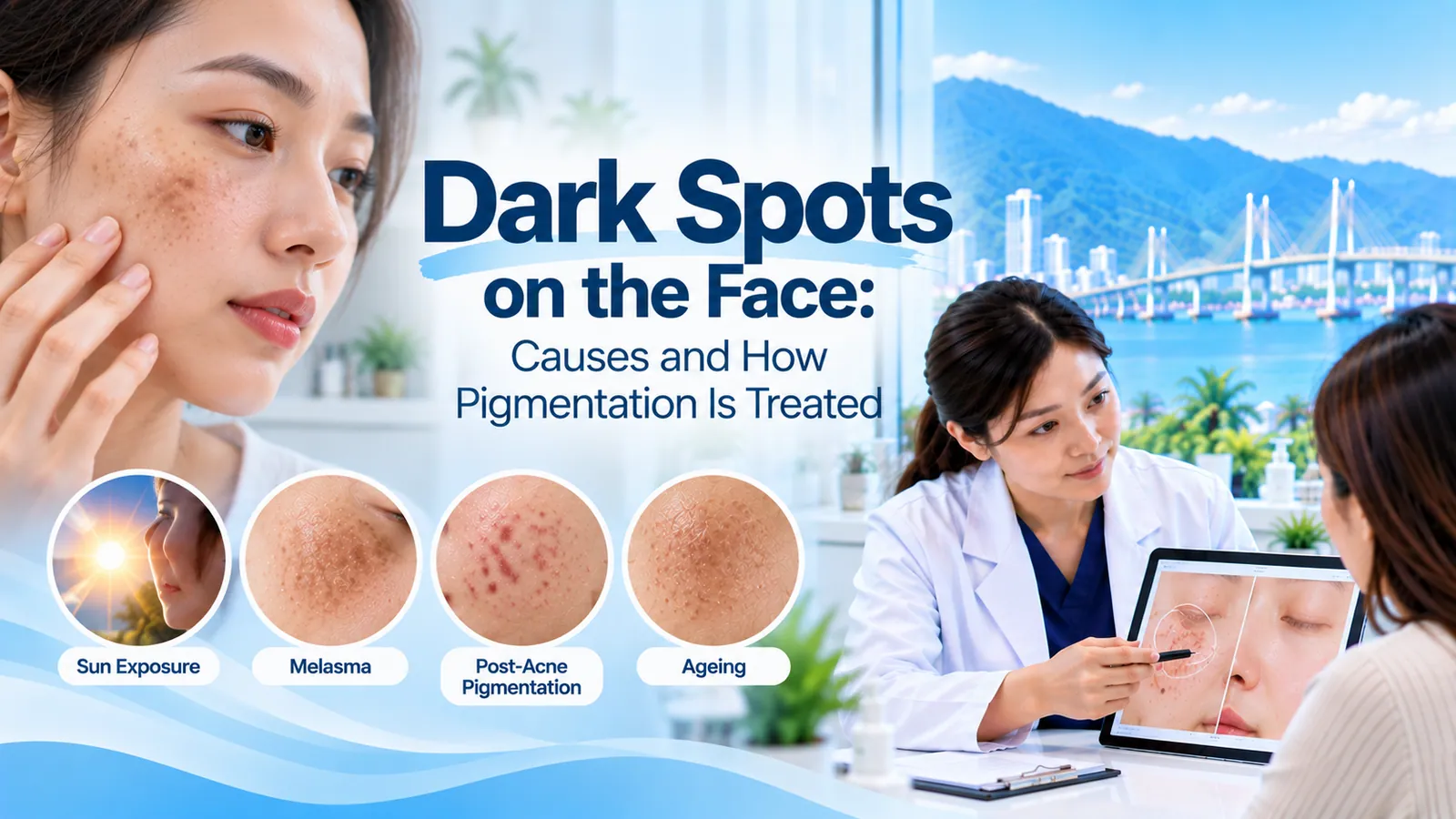
Dark spots on the face are not one condition. Marks left by acne, melasma, sun spots, freckles and the fungal patches Malaysians call panau all look alike in a mirror, yet they respond to completely different treatment — and some darken further with the wrong approach. Working out which one you have is most of the job.
The short answer
Dark spots on the face have several different causes: post-inflammatory hyperpigmentation (flat marks left after acne, eczema or injury), melasma (symmetrical blotchy patches driven by sun, heat and hormones), sun-induced lentigines, freckles, and tinea versicolor — a fungal problem that mimics pigmentation.
Treatment depends entirely on which it is. Daily, reapplied sun protection is the foundation for all of them, improvement takes months rather than weeks, and melasma in particular can rebound darker if treated aggressively.
Why the type matters more than the treatment
Most people shop for a cream or a procedure before anyone has established what the marks are. Take two patients with brown marks on the cheeks. The first has flat marks where spots healed: shallow pigment, acne still active, and the most useful step is controlling the acne so no new marks appear. The second has symmetrical patches that began in pregnancy and darken in the sun: deeper pigment, hormonally and thermally driven, and harsh exfoliation will rebound it darker. Same complaint, opposite plans.
Key points
- At least five distinct conditions present as dark spots on the face.
- Shallow pigment fades faster than deep pigment, so the type predicts the timeline.
- Ongoing inflammation keeps producing new marks — treating the cause stops the supply.
- Melasma can rebound darker after aggressive treatment. Gentler is often better.
- Nothing holds without consistent sun, heat and light protection.
The main types, compared
Each type has a recognisable pattern. Use the table to place your own marks.
| Type | How it looks | Typical cause | What actually helps |
|---|---|---|---|
| Post-inflammatory hyperpigmentation (PIH) | Flat brown, grey or purplish marks exactly where a spot, rash, cut or burn was. Texture unchanged. | Inflammation triggering extra pigment while the skin heals. | Control the original condition first, then patience and sun protection. Prescribed topicals can speed fading. |
| Melasma | Larger symmetrical blotchy patches with soft edges — cheeks, forehead, upper lip. Roughly mirrored on both sides. | Sun, heat and visible light, plus hormonal influence — pregnancy, hormonal contraception. | Rigorous sun, heat and light avoidance; careful prescribed regimens; long-term maintenance. |
| Sun-induced lentigines (sun or age spots) | Well-defined flat brown spots with clear borders on long-exposed skin: cheekbones, nose, forehead. | Cumulative UV exposure over decades. | Preventing new spots with sun protection; assessing any spot that looks atypical. |
| Freckles | Small, light brown, scattered. Present since childhood, darker in sunny months. | Genetic. Sun darkens existing freckles. | Nothing needed — they are normal. Sun protection keeps them lighter. |
| Tinea versicolor (panau) | Pale or darker flat patches with a fine scale — chest, back, shoulders, neck, sometimes face. | Overgrowth of a skin yeast, encouraged by heat and humidity. | Antifungal treatment, not lightening. Colour evens out after the yeast clears. |
Our pigmentation treatment page sets out how each is assessed at DSH.
Marks left after acne are not scars
Post-inflammatory hyperpigmentation is the most frequent reason people in Malaysia notice dark spots on the face. Skin tones richer in melanin — most of the Malaysian population — produce more pigment in response to inflammation, so PIH is both more common and more visible here.
It is colour, not a scar. A scar is a change in structure — a dent, a pit, a raised line. With PIH the surface is intact and the pigment clears on its own over months to a couple of years, faster for recent shallow marks.
So the most effective treatment for it is treating the acne. While spots keep appearing, new marks arrive as old ones fade and the face never looks clear, which makes getting the acne under control the highest-value step rather than something for later. Squeezing a spot pushes inflammation deeper, exactly the trigger for pigment: a spot left alone leaves a lighter, shorter-lived mark.
Melasma: symmetrical, stubborn, easy to worsen
Melasma produces larger symmetrical patches, usually across the cheeks, forehead and upper lip. The pattern is the clue — PIH sits where something happened to the skin, while melasma appears in broad, soft-edged, roughly mirrored patches on both sides.
It responds to ultraviolet light, but also to visible light and heat itself — which matters enormously in Malaysia. A shaded motorbike commute at 1pm, standing over a wok, a humid walk across a car park: sunscreen covers none of that. Patients who protect diligently against UV and still see melasma deepen are usually running into heat and visible light.
It often begins in pregnancy or after starting hormonal contraception, and while that driver continues, surface treatment tends to plateau. It is also prone to rebound — strong peels, hard scrubbing and heat-generating procedures inflame the skin, and inflammation in melasma-prone skin produces more pigment, not less. Melasma is managed and maintained, not cured.
Sun spots, freckles, and the spot that needs checking
Sun-induced lentigines are well-defined flat brown spots on skin with decades of exposure — cheekbones, nose, forehead, the backs of the hands. Freckles are different: genetic, present from childhood, small and scattered, darker in sunny months, and entirely normal.
One exception overrides all of the above. A dark patch changing in size, shape or colour, looking clearly different from your other marks, with an irregular border or several colours, or that itches, bleeds or crusts without healing — and any single new unusual lesion — should be assessed rather than treated with creams. Covering it only delays finding out what it is.
Panau is not pigmentation at all
Tinea versicolor — panau — is a fungal condition of the skin surface routinely mistaken for pigmentation. It gives flat patches paler or darker than surrounding skin with a fine scale, usually on the chest, back, shoulders and neck, and sometimes the face. Malaysia’s heat and humidity make it common, and it often shows up after heavy sweating.
No lightening cream will clear it; it needs antifungal treatment. Even once the yeast is gone the uneven colour takes weeks to months to settle, because the skin has to re-pigment normally — which is why people often think the treatment failed when it worked. It can recur in humid conditions, so maintenance is sometimes advised.
Sun protection in Malaysia is non-negotiable
Without consistent sun protection, every pigmentation treatment underperforms and the pigment returns.
UV is high all year
There is no low-UV season in Malaysia and cloud cover does not remove it. Protection is a daily habit, including on overcast days and indoors near windows.
Reapplication beats the SPF number
A high SPF applied once in the morning protects far less than a moderate one reapplied. Sweat strips it quickly here — reapply every two to three hours outdoors.
Visible light and heat need separate cover
Sunscreen alone does not address the heat and visible light that drive melasma. Tinted or iron-oxide-containing sunscreens cover more of the visible spectrum.
Shade, hats, visors and timing
A wide-brimmed hat, an umbrella, a helmet visor and avoiding roughly 11am to 4pm do more for facial pigmentation than any product — especially for riders and outdoor workers.
Do not stop once it improves
Faded pigmentation is not gone pigmentation. Stopping protection after a good few months is the commonest reason it comes back, and it returns faster than it left.
How long does pigmentation take to fade?
Pigmentation improves over months, not weeks. This is what patients are most often misled about, and why many abandon treatment that was working.
| Type | Realistic timeline | What to expect |
|---|---|---|
| Recent marks after acne | 3 to 6 months | Gradual lightening if the acne is controlled and sun protection is consistent. No new marks is itself progress. |
| Older or deeper PIH | 6 to 24 months | Slower, steady fading. Deep greyish pigment is the most patient-testing of all. |
| Melasma | First change at 2 to 3 months, then maintenance | Managed, not cured. Expect improvement, stable periods, and flares with sun, heat or hormonal change. |
| Sun spots | Little spontaneous fading | The realistic goal is preventing new spots and assessing any that look atypical. |
| Panau | Yeast clears in weeks; colour evens over 1 to 6 months | Patches persist after successful treatment. Expected, not failure. |
Photograph the area monthly in the same light and place. Daily mirror checks cannot detect change this slow, and patients consistently underestimate their own improvement.
What does not work — and what actively harms
Creams bought online or in beauty shops promising to lighten skin within days have repeatedly been found on the Malaysian market to contain undeclared mercury or potent steroids. Potent steroids on the face without supervision cause thinning, visible vessels, steroid-induced acne and rebound darkening worse than the original problem. Mercury is absorbed through the skin and can cause kidney and neurological harm, and Malaysian authorities have issued repeated recalls over exactly these products. A cream that lightens skin dramatically within days is not working the way it claims — stop it and bring the packaging to a doctor.
Aggressive scrubs, daily acids and harsh facials backfire too: they inflame the skin, and in melanin-rich skin inflammation reliably produces more pigment. Pigmentation is also a tendency rather than an event — the drivers remain after any improvement, so maintenance is part of the plan.
On laser, it is worth being clear: it is heavily marketed for pigmentation, but it is not what DSH does. DSH provides non-laser, non-aesthetic medical treatment, and our position is that the diagnosis matters more than the device. Treatment aimed at the wrong type will not hold, and in melasma aggressive treatment can darken the skin rather than clear it.
Do
- Get the type identified before buying anything
- Treat the ongoing cause — active acne, eczema, scratching
- Use sun protection daily and reapply it
- Add shade, a hat or a visor, especially with melasma
- Photograph the area monthly in the same light
- Give correct treatment three months before judging it
- Have any changing or unusual spot assessed
Don’t
- Buy unregulated whitening creams online or in beauty shops
- Use a steroid cream on your face unless told to
- Scrub, over-exfoliate or stack strong acids
- Pick or squeeze spots — it directly creates dark marks
- Stop sun protection once the skin looks better
- Expect weeks when the honest answer is months
- Treat a changing spot — have it checked instead
How DSH approaches facial pigmentation
DSH provides non-laser, non-aesthetic medical skin care, so the work is diagnostic rather than procedural. DSH doctors are fully registered medical practitioners, well trained in evidence-based skin healthcare, able to diagnose, treat and manage skin, hair and scalp conditions. A pigmentation consultation covers:
- Identifying the type — pattern, distribution and history usually settle it, and examination separates true pigmentation from panau.
- Finding the driver — active acne or eczema, sun and heat exposure in your real daily routine, hormonal factors, and whatever is currently being applied.
- Treating ongoing inflammation first, because while it continues new marks form faster than old ones fade.
- Customised topical formulations, matched to the type, your tolerance and the depth of pigment — safe, gradual regimens rather than the strongest option available.
- A realistic sun and heat strategy built around your commute and work, not a generic instruction to wear sunscreen.
- Continuous follow-up — reviewing progress, adjusting, and moving to maintenance once it is stable.
More on our pigmentation and acne pages, or get in touch.
When you probably do not need a visit
You can reasonably manage at home if all of these are true: a few flat marks where spots healed and no new spots appearing; steadily lighter month by month; sun protection used consistently; nothing changing in size, shape or colour, itching, bleeding or crusting.
Arrange a visit if acne, eczema or another rash is still active and producing new marks; the patches are symmetrical and blotchy in a melasma pattern; there is no improvement after three to six months of correct care; you have used a whitening cream, especially one that worked unusually fast; the patches are scaly and may be panau; or any spot is changing or looks different from the rest.
Frequently asked questions
What causes dark spots on the face?
Several different conditions: post-inflammatory hyperpigmentation left after acne, eczema or injury; melasma, driven by sun, heat, visible light and hormones; sun-induced lentigines on long-exposed skin; and freckles, which are genetic. Tinea versicolor (panau) is fungal and often mistaken for pigmentation. Because the treatments differ completely, identifying the type is the most important step.
How long do dark spots take to fade?
Months, not weeks. Recent marks after acne often fade over three to six months; older or deeper pigment can take one to two years. Melasma usually shows its first change at two to three months and then needs ongoing maintenance.
Are dark marks after acne permanent scars?
No. Flat brown or greyish marks left after a spot are post-inflammatory hyperpigmentation, not scars — no skin tissue is lost and they fade over months. A true scar is a change in texture, such as a dent or raised area. The most effective step is controlling the active acne so new marks stop forming.
Do whitening creams work on dark spots?
Unregulated whitening creams sold online or in beauty shops are not safe. Products on the Malaysian market have repeatedly been found to contain undeclared mercury or potent steroids, causing steroid-damaged skin, rebound darkening worse than the original problem, and in the case of mercury, poisoning. Pigmentation should be managed with prescribed topical treatment under medical supervision.
Is laser needed to treat pigmentation?
Laser is widely marketed for pigmentation but it is not what DSH provides — our care is non-laser and non-aesthetic. The diagnosis matters far more than the device: melasma in particular can worsen with aggressive treatment, and nothing holds if the underlying driver and sun protection are not addressed.
Why does my melasma worsen even though I use sunscreen?
Because melasma responds to heat and visible light as well as ultraviolet. Sunscreen does not block heat and most pass visible light, so a hot commute or cooking over a stove can still drive it. Shade, a hat or visor, timing, and tinted or iron-oxide-containing sunscreen cover what plain sunscreen misses.
What is panau and is it pigmentation?
Panau, or tinea versicolor, is a fungal condition of the skin surface causing pale or darker flat patches with a fine scale, usually on the chest, back, shoulders and neck. No lightening cream will clear it — it needs antifungal treatment, after which the colour settles over weeks to months.
When should a dark spot be checked by a doctor?
Any dark patch changing in size, shape or colour, looking different from your other marks, with an irregular border or several colours, or that itches, bleeds or will not heal — and any single new unusual lesion. Pigmentation not improving after several months of correct care is also worth reviewing.
Find out which pigmentation you actually have
Doctor-led, non-laser, non-aesthetic medical skin care across Penang, Kedah and Perak. No referral needed.
Pigmentation treatmentContact us